H2FUTURE
Green Hydrogen
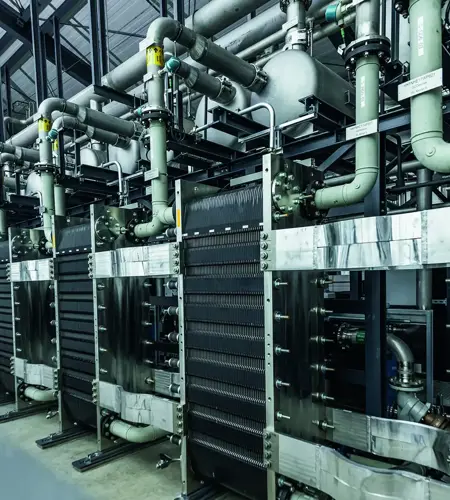
Since 2019, H2FUTURE has been demonstrating how green hydrogen can be produced and used on an industrial scale. At the heart of the project is a 6 MW PEM electrolysis plant. Here, water is split into hydrogen and oxygen using electricity.
The plant is one of the longest-running electrolysis plants of its kind in the world and continues to produce up to 1,200 m³ of green hydrogen per hour.
With H2FUTURE-Follow-Up, the existing research plant is being expanded to include key functions that are crucial for the industrial use of hydrogen: purification, compression, storage and filling up. This shifts the focus not only to the production of green hydrogen, but also to its quality, availability and transportability. In future, the hydrogen produced will be processed using modern purification technology, compressed in several stages and temporarily stored in new hydrogen storage facilities. Four storage facilities will serve to balance fluctuations between production and consumption. This ensures a constant and reliable supply for industrial applications.
For use in industry and research, green hydrogen can in future be compressed to up to 500 bar, bottled and made available for transport by trailer. This means it can not only be used directly on site, but also made available for other applications. A key objective is the use of green hydrogen in voestalpine’s research and pilot projects, including Hy4Smelt and SuSteel. H2FUTURE-Follow-Up thus supports the path towards sustainable steel production with net-zero CO₂ emissions by 2050 at the latest. This expansion creates a research infrastructure that is unique in Europe. Voestalpine and VERBUND are thus laying an important foundation for the practical further development of green hydrogen, testing industrial applications and driving forward the decarbonisation of energy-intensive processes.


H2FUTURE AT A GLANCE
H2FUTURE is a European flagship project for the generation of green hydrogen from electricity from renewable energy sources. Under the coordination of the utility VERBUND, the steel manufacturer voestalpine and Siemens Energy, a proton exchange membrane (PEM) electrolyser manufacturer, a large-scale 6 MW PEM electrolysis system will be installed and operated at the voestalpine Linz steel plant in Austria. The Austrian transmission system operator (TSO) Austrian Power Grid (APG) will support the prequalification of the electrolyser system for the provision of ancillary services. The Netherland's research centre TNO and K1-MET (Austria) will study the replicability of the experimental results on larger scales in EU28 for the steel industry.
H2FUTURE is structured into 10 work packages:
- WP01 Project Management and Coordination (lead: VERBUND)
- WP02 Specification of Pilot Tests and Operation Phase (lead: VERBUND)
- WP03 Detailed Engineering of the Critical Building Blocks (lead: Siemens Energy)
- WP04 Manufacturing and Factory Testing of the Electrolyser System (lead: Siemens Energy)
- WP05 Development and Validation of the Link with Power and Energy Markets (lead: VERBUND)
- WP06 Installation of the Infrastructure for the Electrolyser System (lead: voestalpine)
- WP07 Unit Integration and on-site Validation of the full Pilot (lead: voestalpine)
- WP08 Two Year Demonstration (lead: VERBUND)
- WP09 Impacts of the Project Results and Exploitation (lead: TNO)
- WP10 Dissemination of the Project Results (lead: VERBUND)
The H2FUTURE project has started on 1st January 2017 and has a duration of 4.5 years.